Online PVA development results
The evaluation package is usable without a receiver, but the measured online
estimator is not yet accurate enough to recommend for navigation. The frozen
vehicle_nhc_latched_v1 experiment is No-Go. Production defaults remain
unchanged; the experiment stays an explicit opt-in for reproducibility.
Frozen comparison
Six existing PPC development runs were replayed in full for the control and candidate, both normally and with GNSS outage at 60–70 s and IMU gap at 60–64 s. That is 36 replays and 351,804 output epochs. All six normal runs matched every output timestamp to truth. These are development/regression data, not holdouts. Truth was used only for scoring and scenario labels; no mounting, heading or time-offset fit was performed.
The table reports full-run primary RMSE, control → candidate. Position is fused antenna position norm, velocity is fused antenna velocity norm, and rotation is the full SO(3) error after the first heading latch, including unhealthy outputs. The candidate applies fixed vehicle constraints after that latch.
| Run | Position (m) | Velocity (m/s) | Rotation (degrees) |
|---|---|---|---|
| Tokyo 1 | 72.223 → 52.902 | 6.905 → 2.900 | 104.966 → 12.981 |
| Tokyo 2 | 990.686 → 981.873 | 7.765 → 10.071 | 104.103 → 95.406 |
| Tokyo 3 | 3128.721 → 4721.615 | 14.817 → 112.794 | 105.848 → 111.533 |
| Nagoya 1 | 708.135 → 764.234 | 43.134 → 78.183 | 124.086 → 167.182 |
| Nagoya 2 | 74.755 → 77.884 | 3.998 → 4.851 | 44.406 → 90.488 |
| Nagoya 3 | 79.980 → 125.712 | 6.664 → 7.092 | 104.938 → 103.676 |
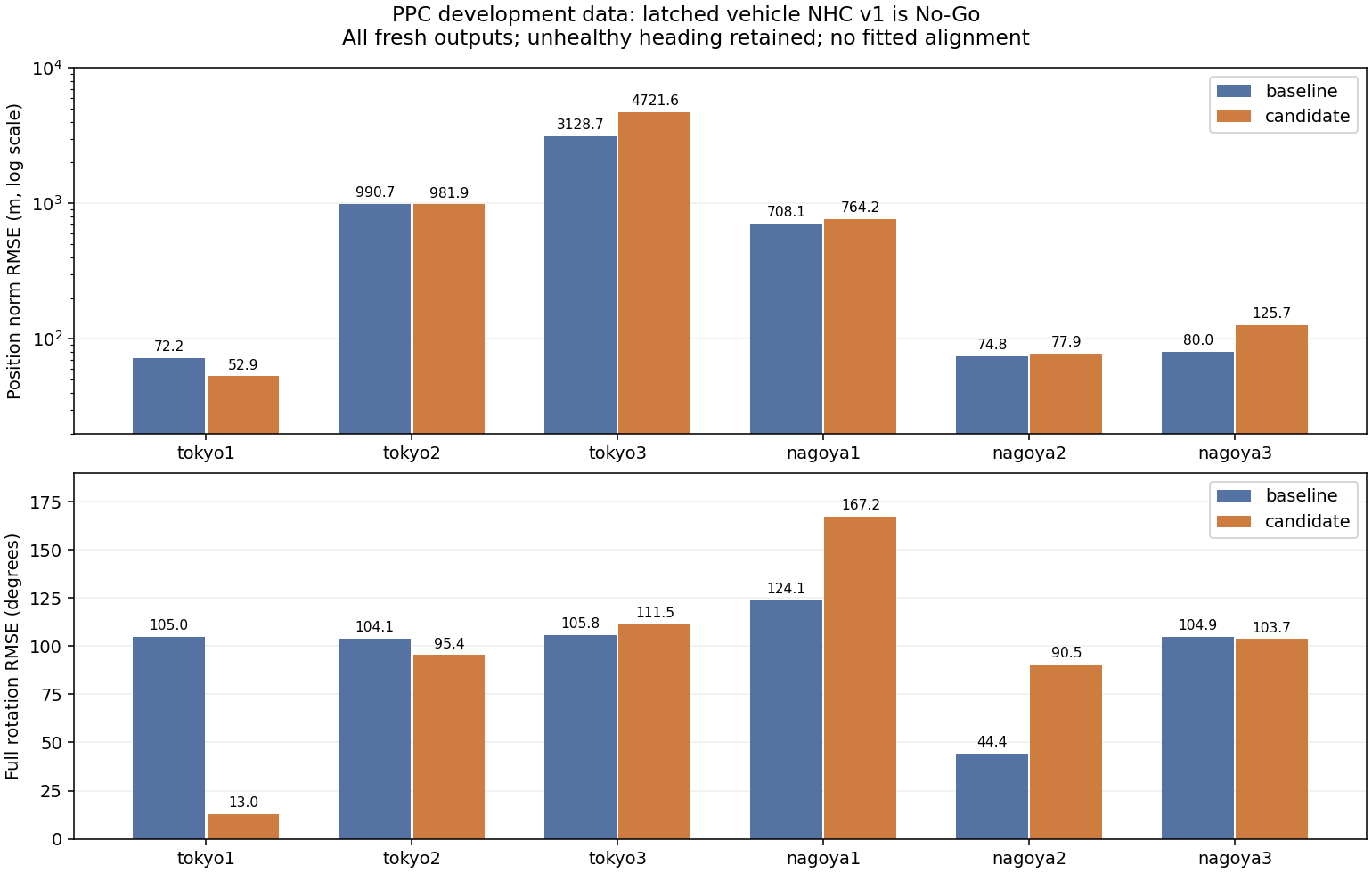
The frozen decision records all 18 run/scenario pairs, all-output and common-valid cohorts, coverage, initialization/recovery, runtime and exact pre-latch parity. There are 134 failed accuracy gates (67 per cohort). All 18 pre-latch parity gates and coverage, delay and runtime gates pass. A strong Tokyo 1 improvement does not satisfy the multi-run non-regression contract. No second candidate was tuned after this result.
Scenario diagnostics
The provenance record contains the 36 original manifests, input/executable/output hashes and 24 additional drift diagnostics. Recomputing these diagnostics verified that every frozen primary metric is unchanged. Drift means the change in position error from the last fresh pre-event output, transported to that anchor's ENU frame. It is a diagnostic of displacement error, not an alignment fitted into estimation or scoring.
Control end-of-GNSS-outage drift is 114.114, 57.866 and 78.740 m for Tokyo 1–3, and 39.285, 7.646 and 193.471 m for Nagoya 1–3. IMU gap diagnostics must be read alongside missing-output counts: the omitted samples cause stale attitude and reset, so a few available samples do not measure a complete four-second bridge. Heading recovery after the gap is 19.4 s in Tokyo 1, 13.0 s in Tokyo 2 and 2.4 s in the other four runs. Censored recovery is null.
Stop, low-speed, turn and reverse populations and per-scene errors are retained in each score. Nagoya 1 has 115 reverse labels, 96 with a latched heading, and heading RMSE 115.469 degrees (P95 177.165). Nagoya 2 has 13 reverse labels and heading RMSE 2.052 degrees; the other four runs have no reverse population. Absence of such a scene is not evidence of robustness in it.
A fixed loose-only ablation improves the first 600 Tokyo 1 position outputs but retains roughly 100-degree rotation RMSE. Recorded bias diagnostics show large estimated gyro bias despite small observed angular rate. These support weak observability/spurious bias learning as an investigation target; they do not establish a single cause. The next estimator change needs a new contract.
Validation and distribution scope
The online API unit lane passes all 11 cases; PVA scoring and comparison tests cover coordinate transport, quaternion sign, unhealthy 180-degree error, missing data, censored recovery, drift and tampered provenance. A 600-epoch production replay also passes prefix invariance and a 300-epoch common prefix; default candidate-none outputs match the frozen control exactly in all 54 deterministic common CSV fields (wall-clock processing time is excluded).
The broader Windows checks pass 158 CLI tests (65 skips), 180 benchmark tests (one skip), four binding tests (eight skips), and installed packaging smoke checks. The main C++ suite passes 1,274 cases (65 fixture skips). Full CTest passes 130 of 139 lanes; the same nine pre-existing failures involve paused smartphone records with Windows newline hashes, POSIX-only resource APIs or an absent external artifact. They were not rewritten to make the run green. ROS2 execution is unverified because its node binary/dependencies are absent.
Use the PVA guide for Docker, Windows ZIP and Linux TGZ/DEB commands. Synthetic fixtures check the scoring workflow; public PPC data are external and not bundled. Each locally produced artifact has its own checksum and platform smoke evidence. Published v0.2.0 artifacts do not contain this development branch. No new release, PR or merge is implied by these results.
The local delivery record pins four artifacts, their platform/runtime requirements, installed-only evaluation manifests, the default parity comparison and the production prefix proof. Windows ZIP and Docker both replay 600 public epochs and produce plots from installed files alone. DEB and TGZ pass demo, plot, native startup and explicit binding import checks in fresh compiler-free Ubuntu 24.04 containers. The TGZ native binary hash matches the Docker binary used for the public replay. The Docker archive was reloaded successfully. Strict documentation, actionlint hygiene and the prescribed cppcheck script pass; existing style warnings are retained.
The artifacts are under E:/gnsspp-pva-development/dist-final-windows and
E:/gnsspp-pva-development/dist-linux in this local workspace, with
SHA256SUMS beside them and README-distributions.txt in the parent directory.
The DEB has development version 0.2.0+pva.1091b8c3; the TGZ and ZIP filenames
also identify their development source. These paths are not public downloads.
The native component was built at 7671c9af; production C++ is unchanged through
the package source 1091b8c3. Scripts/install rules were rebuilt incrementally.
The subsequent packaging fix e45f87a1 adds the ELF inspection prerequisite;
that prerequisite was installed for the successful local DEB build.
Post-freeze bug-fix re-baseline: SPP cold-start lockout
This section is a bug-fix re-baseline made after the v1 records above were
frozen. It does not edit or supersede online_pva_decision_v1.json or the
provenance/delivery records; those still describe the frozen candidate.
The online PVA replay never sets obs.receiver_position, so the SPP core
seeded its linearization point at 0.9 x the first satellite position. From that
point only two or three satellites passed the elevation mask, SPP returned no
solution, and the same seed was reused on every later epoch: a permanent
lockout. On PPC Tokyo run2/run3 and Nagoya run1 about 80% of epochs (Tokyo) had
rtk_status 0 and the fused position was kilometres off.
The SPP core now bypasses the elevation mask while a cold start is unsettled
(RTKLIB rescode() does the same for an unset receiver position), applies the
mask again once the Newton step is below 1 km and always for the final
measurement set, and re-seeds on the next epoch if a cold-start epoch fails.
Solves with a known position (RINEX header, previous solution) are unchanged.
Default build, full six-run gnss pva-evaluate, before (frozen-control
behaviour) and after:
| Run | rtk_status 0 | Position RMSE / P95 [m] | Velocity RMSE / P95 [m/s] | Rotation RMSE / P95 [deg] |
|---|---|---|---|---|
| Tokyo 1 | 0.7% -> 0.7% | 71.65 / 155.2 -> 71.65 / 155.2 | 7.05 / 14.6 -> 7.05 / 14.6 | 105.1 / 171.1 -> 105.1 / 171.1 |
| Tokyo 2 | 80.7% -> 0.4% | 990.7 / 1470 -> 74.2 / 179.5 | 7.77 / 14.5 -> 6.85 / 14.1 | 104.1 / 170.8 -> 100.3 / 170.0 |
| Tokyo 3 | 80.5% -> 0.0% | 3128.7 / 5342 -> 41.9 / 115.0 | 14.82 / 19.1 -> 3.22 / 8.2 | 105.8 / 171.4 -> 63.5 / 144.4 |
| Nagoya 1 | 0.9% -> 0.7% | 708.2 / 476.9 -> 49.3 / 118.1 | 47.81 / 100.0 -> 4.61 / 9.8 | 118.3 / 173.4 -> 88.2 / 168.7 |
| Nagoya 2 | 0.3% -> 0.3% | unchanged (81.0 / 168.0) | unchanged (3.73 / 10.0) | unchanged (18.5 / 39.8) |
| Nagoya 3 | 0.0% -> 0.0% | unchanged (58.9 / 128.1) | unchanged (5.54 / 11.7) | unchanged (105.0 / 170.9) |
Rotation RMSE stays large on most runs: that is a separate heading-initialisation
question, not addressed here. Tokyo 1 differs from the old control only in the
third decimal. Outputs are under
rtklib_v2_ws_output/spp_coldstart_fix_20261008/ in the local workspace.