Camera–LiDAR: what the wrong pitch-control poses match
Finding: the nearest-ridge score can prefer a visibly displaced projection over the dataset reference. Small pitch error alone also hid large roll/yaw errors in the fitted baseline. This diagnostic explains the previous negative result; it is not another optimizer run or a calibration improvement.
Fixed-pose replay
Use the saved nearest-ridge pitch-axis folds for 2011_09_28_0002, pitch +3. Verify the snapshot and source hashes, recreate the existing prepared frames, and score the saved baseline and both saved nuisance-refitted controls. Undo the known injected rotation for a fourth pose, the dataset reference. No pose is fitted or selected for adoption using these scores.
All six saved held-out control drops reproduce within absolute 1e-9. Every per-point contribution sums to the existing objective within absolute 1e-12, including zero contributions outside the image and the unchanged denominator. The existing preparation retains 11 of the 38 captured frames; this diagnostic uses all 11, without changing frame selection. A synthetic test checks bilinear attribution and preservation of out-of-image point weight.
All frame scores and attribution
are retained with a schema and hash manifest.
The generator is tools/kitti_camera_lidar_match_diagnostics.py; plotting requires
Matplotlib in addition to the research environment's existing dependencies.
Whole-pose errors change the interpretation
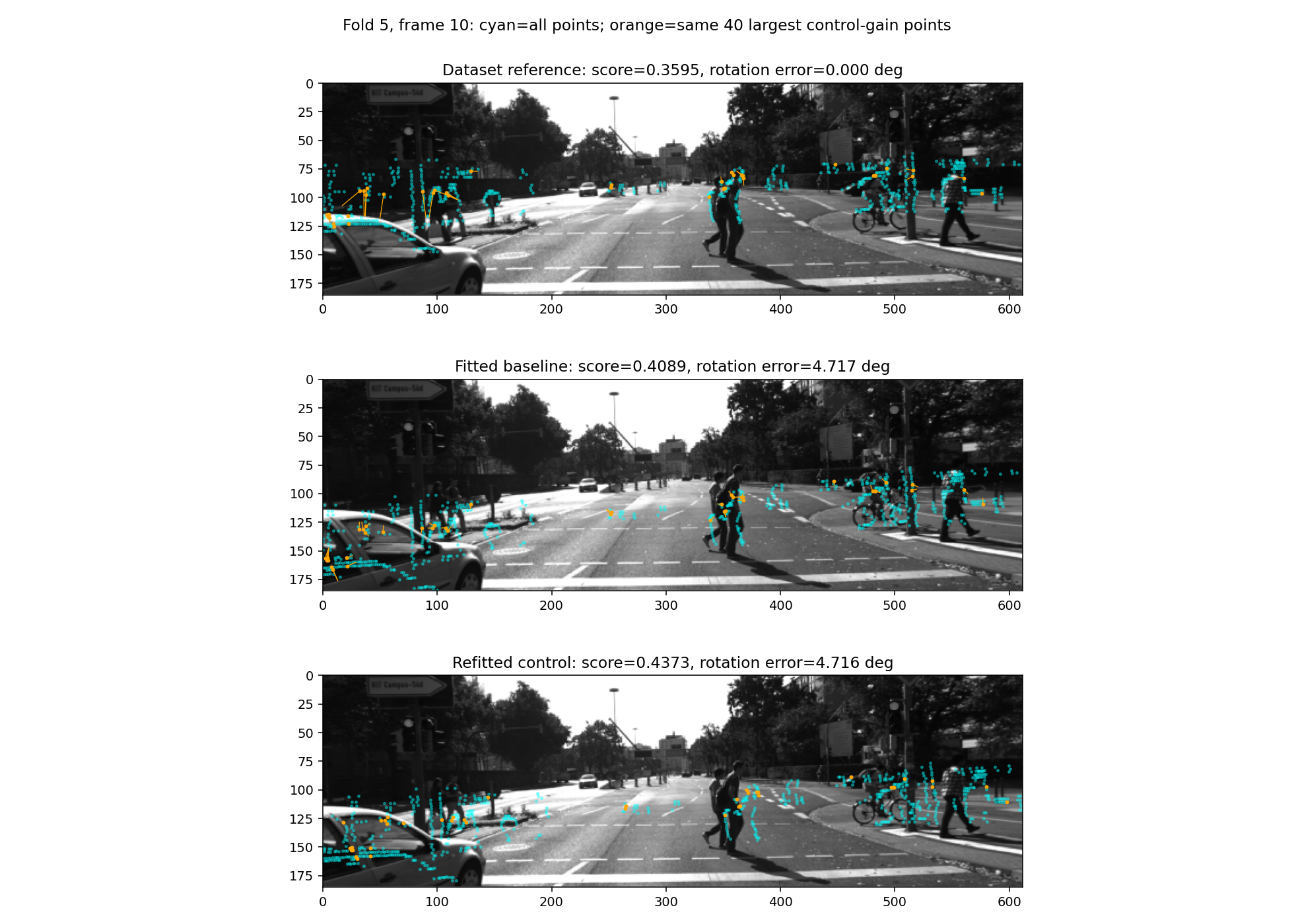
The earlier nearest-ridge report correctly described active-axis pitch errors within 0.052 deg, but this must not be read as an accurate full rotation. The reference-relative rotation-vector norm of the fitted baseline ranges from 0.638 to 4.717 deg because roll/yaw can move during nuisance fitting.
| Fold | Baseline full rotation error (deg) | Reference score | Baseline score | Minus-pitch control score | Plus-pitch control score |
|---|---|---|---|---|---|
| 0 | 3.858 | 0.4435 | 0.3329 | 0.3257 | 0.3255 |
| 1 | 2.761 | 0.3855 | 0.4563 | 0.4462 | 0.4291 |
| 2 | 0.642 | 0.4833 | 0.5035 | 0.5534 | 0.5472 |
| 3 | 0.638 | 0.4507 | 0.4814 | 0.5747 | 0.5532 |
| 4 | 1.604 | 0.4214 | 0.4192 | 0.3928 | 0.5152 |
| 5 | 4.717 | 0.3743 | 0.4135 | 0.3631 | 0.4384 |
At least one saved control beats the reference in five of six pooled folds and 10 of 11 individual frames. It beats the fitted baseline in four pooled folds. These are descriptive comparisons against two existing controls, not independent success trials or new held-out claims. The repeated failures mean this example is not explained solely by one bad frame or one training initialization.
Visible match substitution
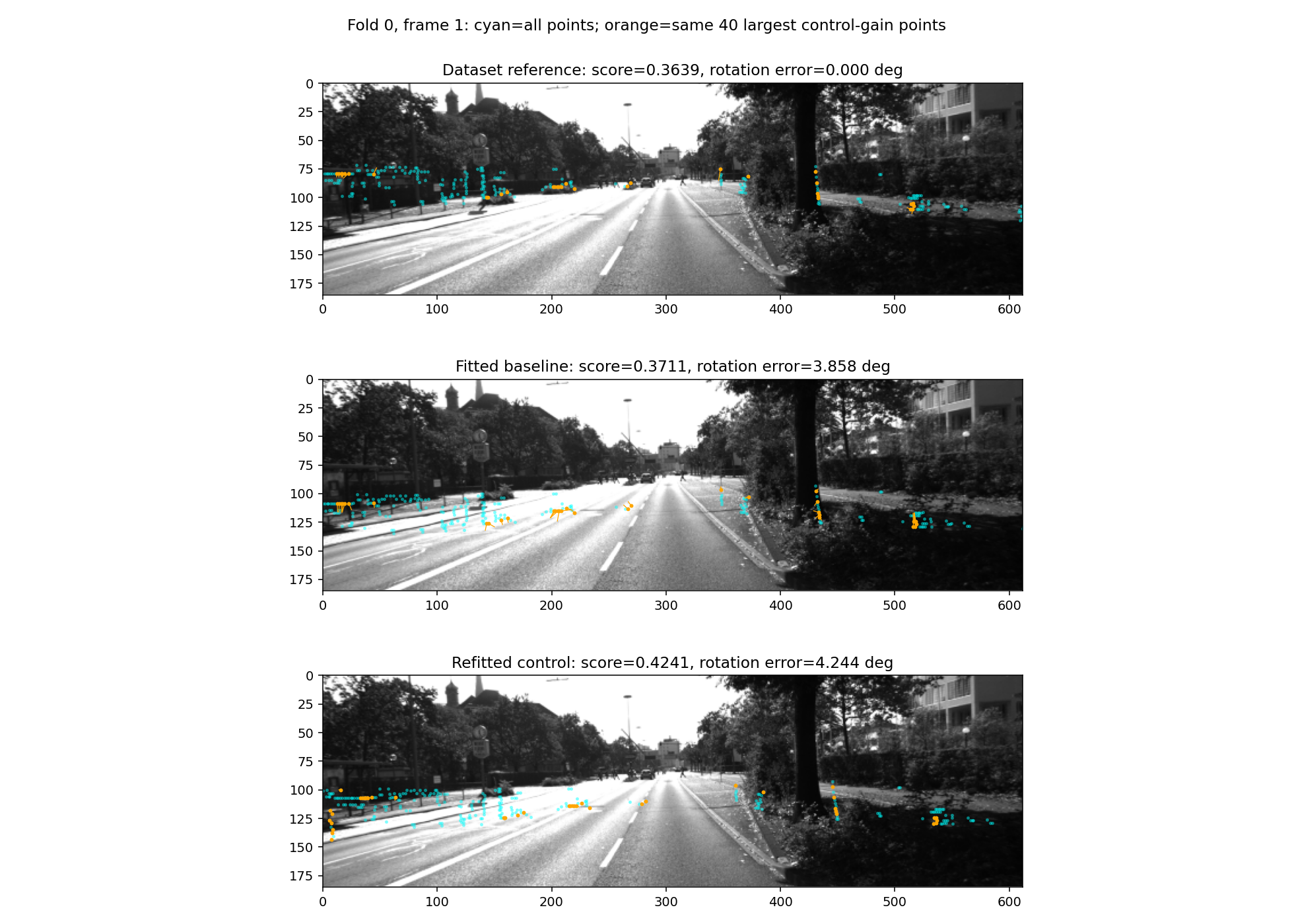
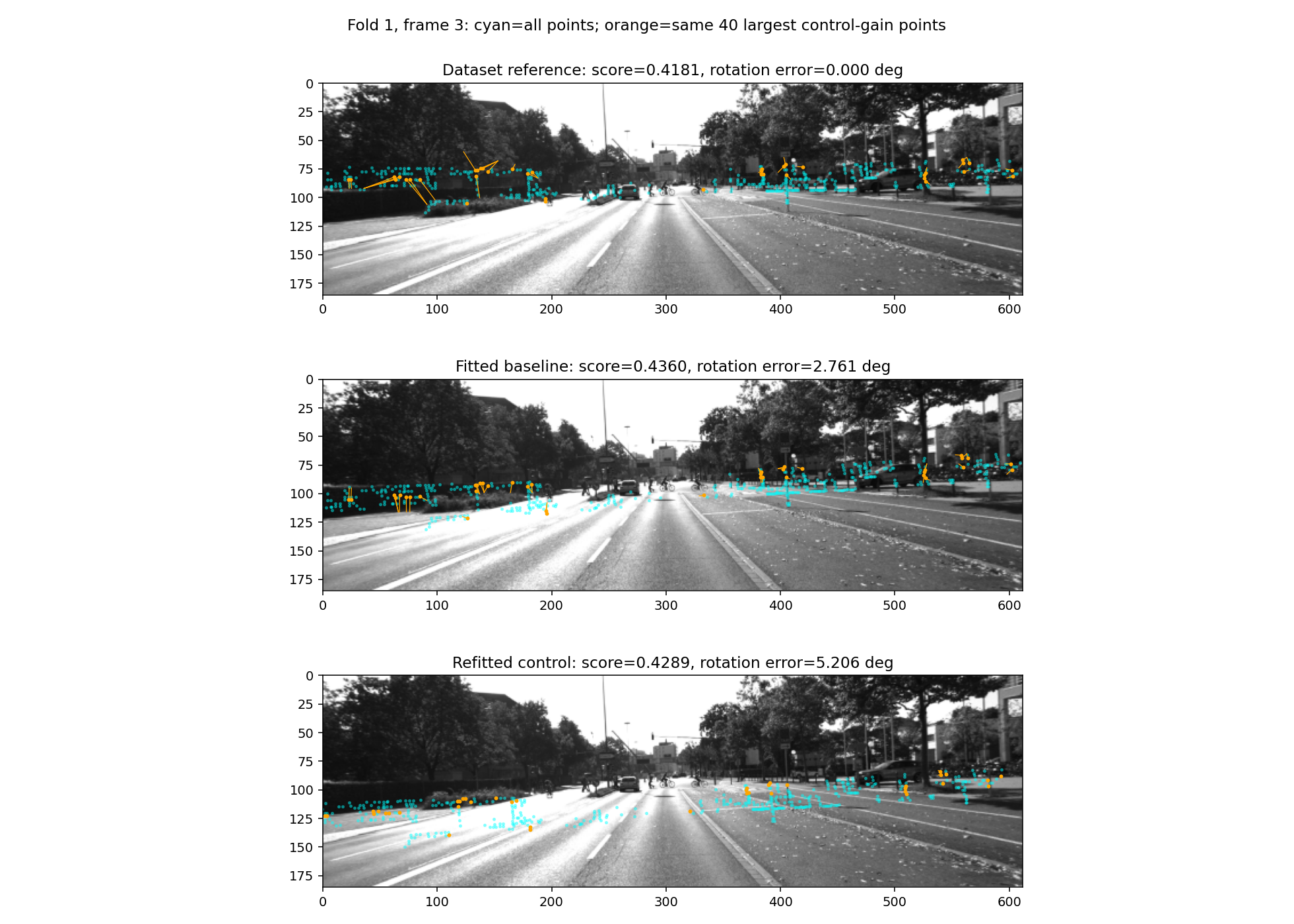
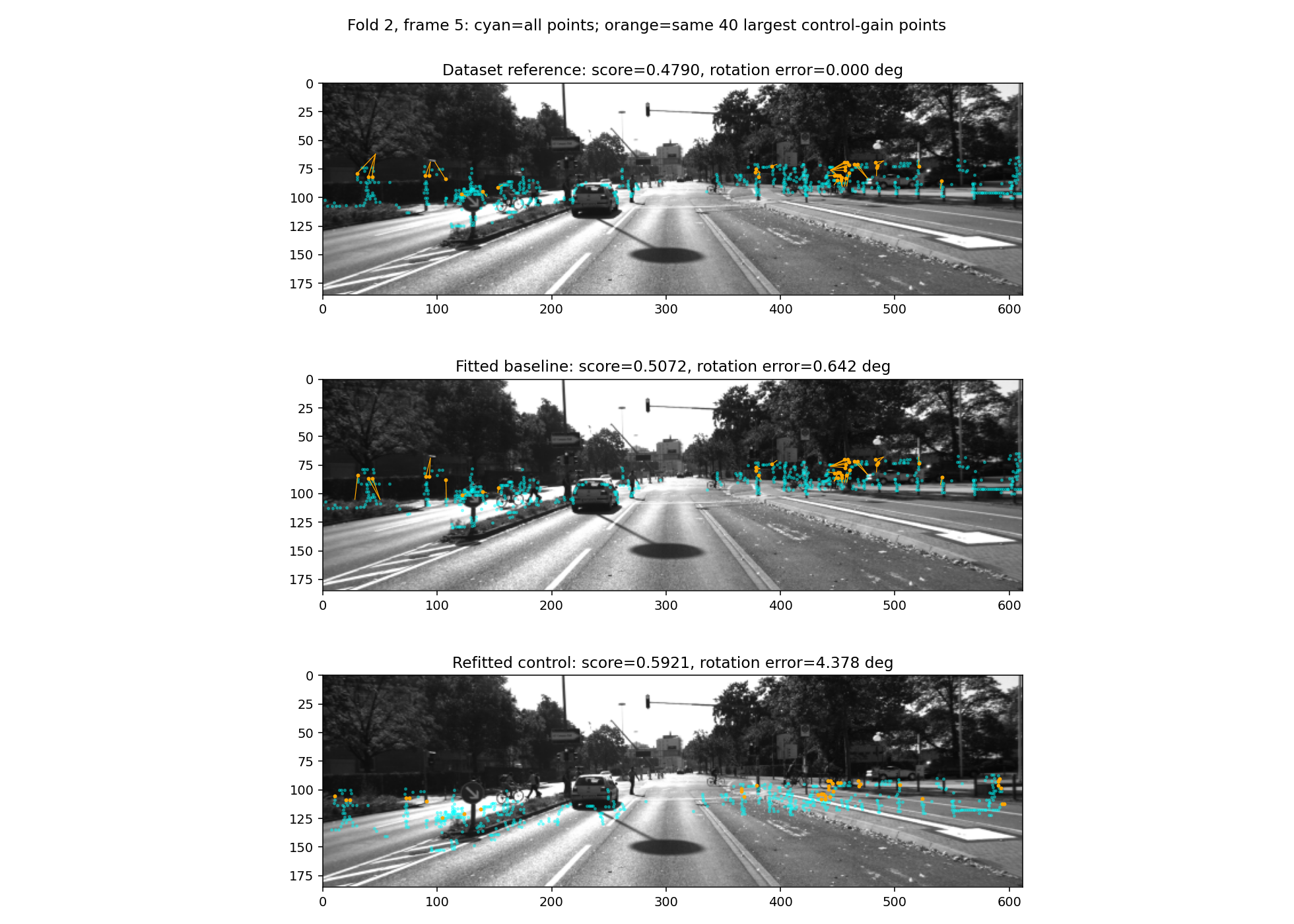
Each figure uses the frame/control pair with the largest control-minus-baseline score in its fold, including the least-negative pair when neither wins. All six examples are retained; this selection is explicitly post hoc. Cyan shows all prepared points; orange identifies the same 40 largest positive-gain-ranked points across the three poses. Lines connect those projections to a nearest image ridge using rounded image pixels for illustration; exact scores use bilinear sampling.
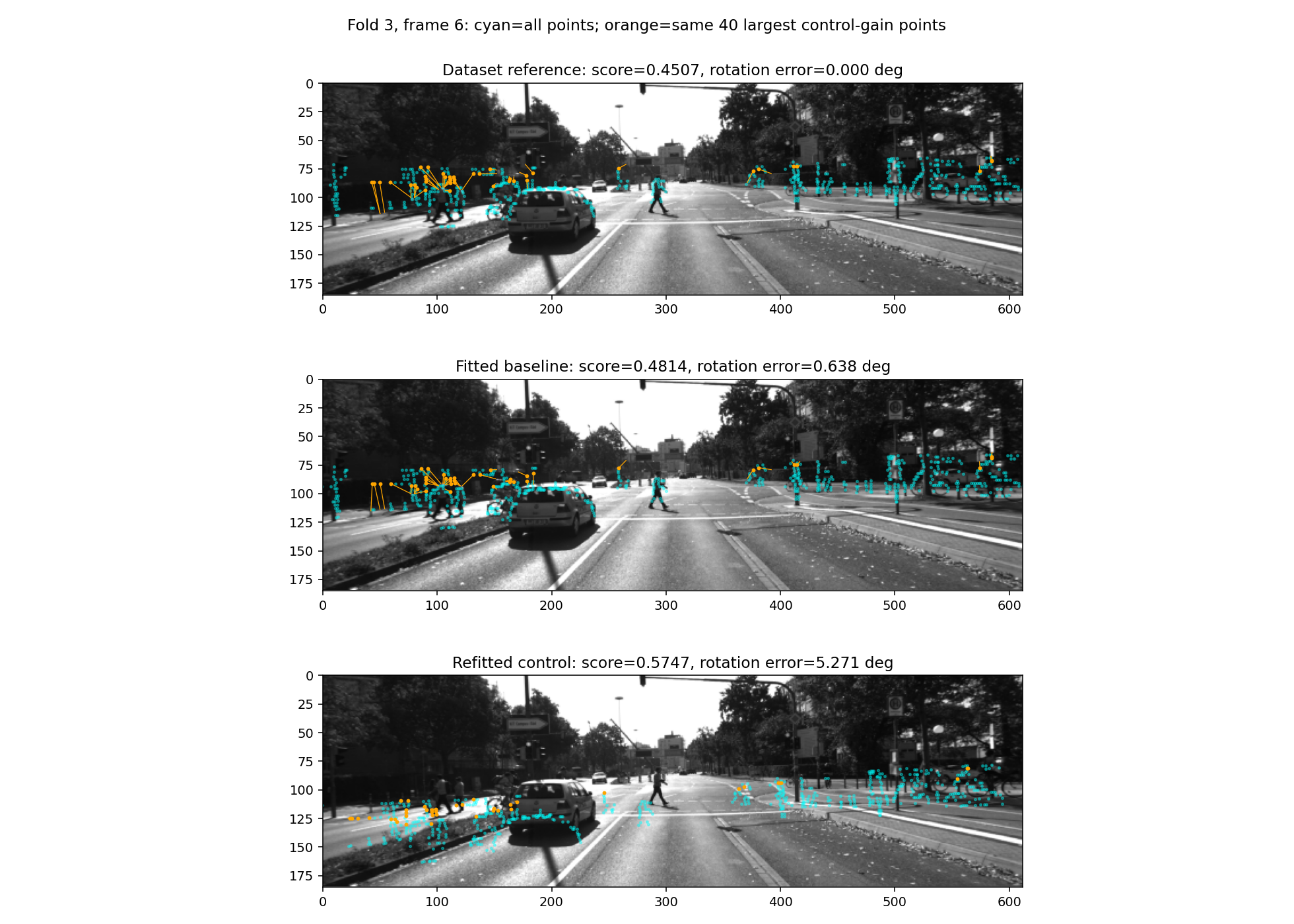
In fold 3, a control with 5.271 deg full rotation disagreement scores 0.5747, versus 0.4507 for the reference. The point pattern shifts down toward sidewalk and road-side contours rather than preserving the reference boundary locations. The displacement is visible across the image, not only on the car.
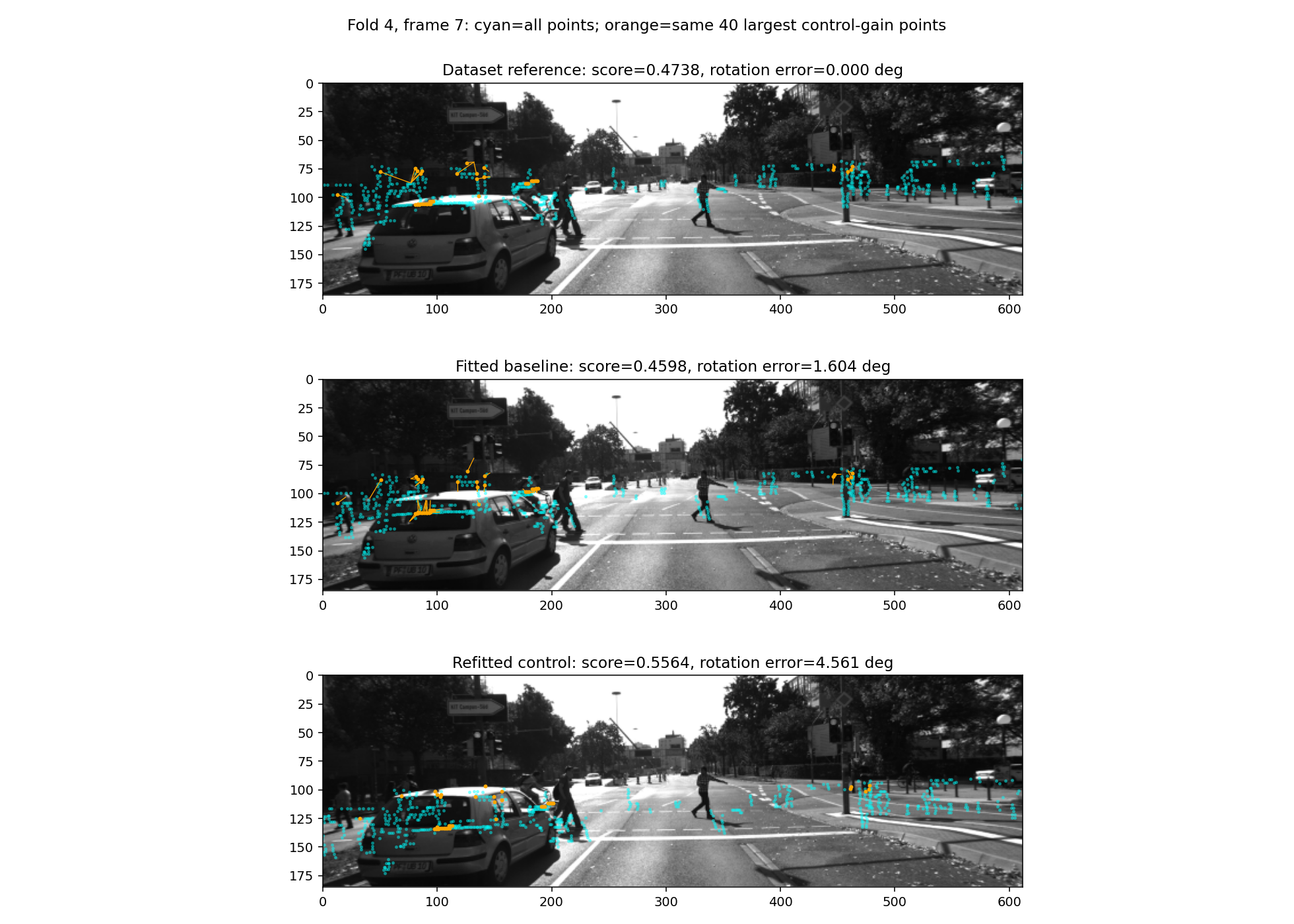
In the fold 4 example, some points near the car roof in the reference projection move onto window/body contours under the control. The wrong pose has 4.561 deg full rotation disagreement yet scores 0.5564 versus 0.4738 for the reference in that frame. These object descriptions are visual interpretations, not annotated semantic ground truth or proof that a specific surface caused every gain.
Other examples: fold 0, fold 1, fold 2, and fold 5.
Development consequence
Do not pursue another distance cutoff or score threshold adjustment. The next hypothesis should preserve boundary identity or structure across matches, rather than rewarding arbitrary nearby image ridges independently. Report full rotation error alongside active-axis error in future ablations. Repeated wrong-pose score advantages across nearby frames mean temporal score consistency alone is not a sufficient fix; actual correspondence identity must be checked. This diagnostic does not track 3D identities across frames and cannot establish that such a method will work. No native defaults, prior verdicts or audit thresholds change.